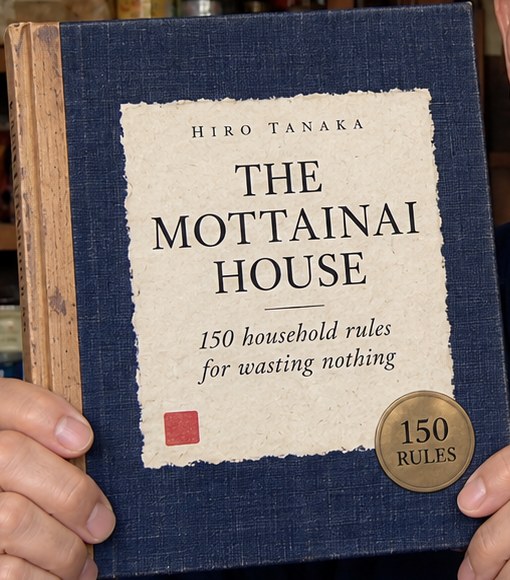
Most money does not leave your house at the register. It leaves through the drawer of things you forgot you owned, the food at the back of the fridge, the shirt thrown out over one loose button. In this book I have written down the 150 rules my household lives by: small, plain habits that make food last, clothes last, tools last, and money last. Nothing here asks you to buy anything. Most of it asks you to look at what you already have.
By clicking, you agree to our Terms and Privacy Policy.
$27, one time. Card, Apple Pay or Google Pay. Nothing recurring, ever.
The book and the printable Reference Pack download straight away, on your phone or computer.
We email you the link too, so you can download it again whenever you need it.
It leaves quietly, a little every week, through habits nobody ever questioned. These are the leaks I see in almost every house, and the rules that close them.
One book, $27 once, and nothing new to buy.
Five short lines, so you can find your place with wet hands and a busy head.
The contents
Before you buy any small household thing, open the drawer where it would live.
Most houses own two or three of the same tape, batteries, scissors and chargers. Not because anyone wanted three, but because the first one was hidden when it was needed.
Empty one drawer on a towel. Group what matches. Keep the best of each. The rest goes into one clearly labeled box: this is now your shop.
The next four or five purchases are already paid for.
Never buy a new organizer to hold the duplicates.
A full rule, from Chapter Seven
Stick it inside a cupboard door. Use it before anything over twenty dollars.
One of 10 printable pages

You do not need to read 150 rules before anything changes. Start with these seven.
Visa Β· Mastercard Β· Amex Β· Apple Pay Β· Google Pay
βA practical household guide built on years of actual work, not trends.β
Anna, New Mexico Β· verified buyerβHiro, you write the way a person talks at the kitchen table. I can hear the voice. Thank you for putting the work down for the rest of us. I am still early in the pages and already shopping differently.β
R L, Georgia Β· verified buyerβThe book uses what I already keep at home, so I am not running to the store for a new bottle every week.β
Lisa, Washington Β· verified buyerβThree kids, two dogs, and I used to drop $40β$50 every couple of months on things we already owned. Most of those doubles are gone now. The duplicate drawer actually worked. Hiro is a little stern and I donβt mind.β
Denise Β· verified buyerβMy wife ordered it. I figured it would be another βbuy lessβ sermon. It isnβt. He gives real measures and he tells you when a trick will fail. Our fridge is emptier and our bill is lower.β
James Β· verified buyerβGot it on my lunch. Tried the use-first box that night. By morning the forgotten leftovers were gone. I am 58 and this is the first household book that didnβt lecture me or push a membership.β
Sandra Β· verified buyerβIf you have ever rented, the storage chapter pays for the whole thing. I printed the Cost-Per-Use cards and taped them in the cupboard. My mother would have gone along with this man.β
Ashley Β· verified buyerβThis is how my grandmother kept house. Same respect for what is already paid for. I teared up on the opening pages.β
Rosa Β· verified buyerβThe price of a PDF made me pause. I kept the seven-day promise in my back pocket all week. Never used it. The fridge rules, the mending notes, the energy ones β all better. He is honest when something will not be enough.β
Linda Β· verified buyerβThe Cost-Per-Use card belongs on every cupboard door in the country. Direct. No padding. I already saved more than I paid by skipping another charger and another set of batteries.β
Patricia Β· verified buyerβI am 29 and nobody taught me this. The book does not make me feel foolish for starting late. It just tells me the next step.β
Brittany Β· verified buyerβThe printable pages are the best idea in it. Printed, laminated, inside the cabinet. Wet hands, I can still read the chart.β
Nancy Β· verified buyer
I am 72 years old. I have lived most of my life in the same kind of house: small, full of things that were bought once and kept for a long time.
My mother kept a house where nothing left until it had given everything it had. It was never about being poor. It was respect for what had already been paid for. We have a word for the feeling when that respect is missing: mottainai. It does not mean keeping everything. It means noticing the value that is still there before you throw it away.
These are the habits of my household and of many homes I know. I do not speak for every home in Japan, and I will not pretend there is a magic trick here. There are only small rules, kept every day.
I am not selling you a new life. I am showing you the one you already paid for.
No. It is a digital book (PDF) that you download straight away. Many people print the Reference Pack and keep it on the fridge or inside a cupboard door.
Yes. It opens on any phone, tablet or computer. The rules are short, so it is easy to read one while you stand in the kitchen.
No. You pay $27 once. There is nothing recurring and nothing to cancel.
The download link is in the email we send you after purchase. If you cannot find it, write to us and we will send it again.
Because one rule, like the fridge check or the forgotten subscription, usually pays for the book in the first month. The other 149 are the rest of the house.
Some of it, scattered across a thousand videos and posts. This is the whole system in one place, in order, with the reasons behind each rule and the mistakes that undo it.
No. That is the point of the book. Almost every rule uses what you already own.
No. The rules come from a Japanese household, but they are written for any home: an apartment in Ohio, a house in Leeds, a farmhouse in Norway. Waste looks the same everywhere.
Write to us within 7 days and you get a full refund. You keep the file.
150 rules, 10 Chapters and 10 printable pages, for $27 once.
7-day money-back guarantee Β· Instant download